Book an appointment
Impladent Offer Microscope-Assisted Root Canal Treatment

Microscope-Assisted Root Canal Treatment

Root Canal Treatment According to Global Standards

Experienced endodontists

State-of-the-art technology: endodontic microscope, endometer, standard use of a rubber dam,

Thousands of teeth saved, including the most difficult cases

Painless, one-visit treatment

Procedures performed under anesthesia, without the need to remove the tooth

Book an appointment

Root Canal Treatment—When Is It Necessary?

Root canal treatment is often the last chance to save a tooth from extraction. It not only allows you to keep your own tooth but also protects your body from the spread of bacteria that can cause serious diseases, including heart, kidney, and joint conditions.

The most common indication for endodontic treatment is irreversible pulpitis. This is a complication of untreated tooth decay, in which bacteria penetrate deep into the tooth and cause inflammation. Symptoms include pain, sensitivity to hot and cold, and discomfort when biting down. However, pulpitis can sometimes be chronic and show no obvious symptoms—in such cases, the condition leads to necrosis and periapical lesions.

In such cases, professional root canal treatment at the Impladent Clinic in Gdańsk is the only way to save your natural teeth and avoid extraction.

What is root canal treatment?

Modern root canal treatment is neither painful nor stressful. At our clinic, endodontics in Gdańsk combines the experience of our dentists with the latest technology.

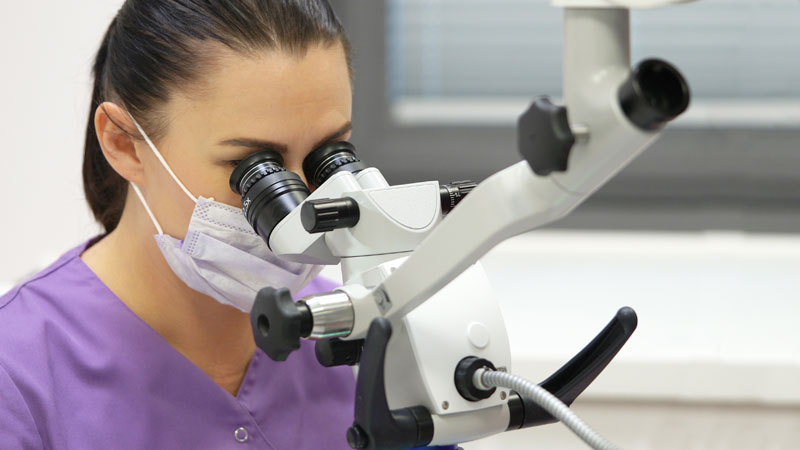
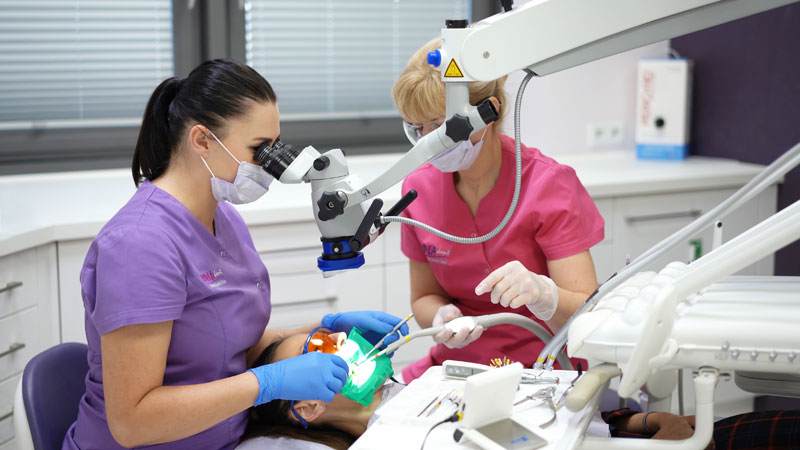
For precise root canal cleaning, we use an endodontic microscope, which allows us to see even hard-to-reach areas. An electronic endometer enables accurate measurement of root canal length, and a rubber dam protects the patient’s mouth from chemicals and bacteria in saliva. We perform the filling using natural, biocompatible gutta-percha, which is well tolerated by the body.

The treatment was performed by Dorota Jaraczewska-Brożyńska, D.D.S.


's Step-by-Step Guide to Root Canal Treatment:

1 Step

Radiological diagnostics (X-rays, CBCT scans) to assess the condition of the tooth and root canals.

2 Step

Anesthesia and treatment of cavities under a microscope.

3 Step

Placing a rubber dam and isolating the tooth from the rest of the mouth.

4 Step

Radiological diagnostics (X-rays, CBCT scans) to assess the condition of the tooth and root canals.

5 Step

Anesthesia and treatment of cavities under a microscope.

6 Step

Placing a rubber dam and isolating the tooth from the rest of the mouth.

The treatment was performed by Dr. Anna Grabowska, D.D.S.

Root Canal Retreatment – Reendo

Sometimes, previous treatment has not produced the expected results, and the patient continues to experience pain. This may be due to a leaky filling or a poorly prepared root canal.

In such situations, root canal retreatment—known as a “reendo”—is necessary. This procedure involves removing the old filling, thoroughly cleaning the canals, and sealing them again. At Impladent, we perform reendo using a microscope, which allows us to treat even the most difficult cases—including the removal of broken instruments from the root canals. Thanks to this, patients have a real chance of saving a tooth that would otherwise have to be extracted.

Precise, Modern Endodontics

The root canals of a tooth may become narrowed or obliterated (closed), for example, due to trauma, inflammation, or age-related changes. In such cases, endodontic treatment is extremely difficult.

That is why at the Impladent Clinic we use CBCT imaging to perform a detailed analysis of the tooth. In the most complex cases, we create a custom endodontic guide for the patient, which guides the instruments in a minimally invasive manner and allows us to preserve as much of the natural tooth structure as possible. This approach guarantees high effectiveness while providing maximum protection for the tooth’s structures.

Figure 1: A partially obstructed root canal in a tooth following trauma; the canal lumen is visible below the midpoint of the root.

Figure 2: Root Canal Treatment Using an Endodontic Guide

Figure 3: Endodontic template

Figure 4: Blocked root canal—clearing the canal using an endodontic template.

Figure 5: Condition after reopening and filling the obliterated canal while preserving as much of the tooth’s natural structure as possible.

Treatment and photos:


Wiesława Puchalska, D.D.S.

Specialist in Restorative Dentistry with a Focus on Endodontics

Your most frequently asked questions

Is root canal treatment painful?

Modern root canal treatment is performed under local anesthesia, making it completely painless. There may be some minor discomfort once the anesthesia wears off, but this can be managed with standard pain relievers.

How long does root canal treatment take?

The duration depends on the complexity of the case, the number of root canals, and whether it is a first-time endodontic treatment or a retreatment. Simple cases can be completed in a single visit lasting 1–2 hours, while more complex cases require two or more visits.

When is microscope-assisted root canal treatment necessary?

Microscope-assisted root canal treatment is the standard in modern endodontics. A microscope is essential for treating complex cases (e.g., narrow, curved canals, retreatment) and minimizes the risk of failure.

How long do the results of endodontic treatment last?

A root canal treatment performed correctly has lasting results. With proper oral hygiene and regular checkups, the tooth can last for many years. A tight filling and restoration are key.

What will happen if I decide not to have root canal treatment?

Failure to undergo endodontic treatment leads to the further progression of the infection, severe pain, the formation of abscesses, and periapical lesions. Ultimately, the untreated tooth will have to be removed (extraction), which entails the cost of prosthetic restoration.

Book an appointment

Do you have a toothache or need root canal treatment in Gdańsk?

At the Impladent Clinic, we provide modern, pain-free endodontic treatment using a microscope and the latest technologies.
Contact us to schedule a root canal appointment at Impladent Gdańsk.